
The Blue Boy
on the three centuries in satin

He’s been called a dandy, a masterpiece, a symbol, a meme. But mostly, he’s been looked at.
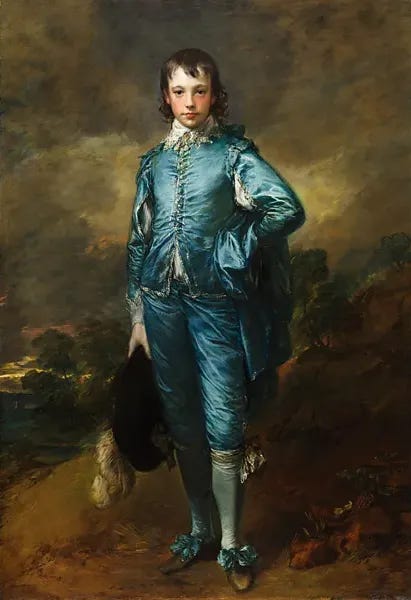
In 1770, Thomas Gainsborough painted a boy in blue satin. Standing against a stormy landscape, he meets our gaze with unflinching calm, one hand on his hip, one gloved hand dangling loose. For a portrait so still, The Blue Boy has lived a restless life.
Across three centuries, he keeps changing clothes without ever changing costume.
I. The Boy in the Satin Storm
When Gainsborough first unveiled The Blue Boy, it was pretty much a rebuttal. Joshua Reynolds, the founder and first president of the Royal Academy, who favored grand, formal, and often idealized portraits, had famously declared that blue should only ever be used as an accent color, never the main act. Gainsborough disagreed and really dressed his subject head-to-toe in it.
The costume itself was already an antique of the time. A relic from another era, where it ensembles the courtly elegance of Anthony van Dyck’s portraits. The doublet, with its intricate buttons and fitted lines, and the voluminous lace collar, could have stepped straight from Van Dyck commissions. Yet Gainsborough infused this historical attire with a vitality entirely his own.
The lace catches the light and flutters with movement, the satin shimmers under the brush, and the folds of fabric are alive. The ensemble doesn’t merely dress the boy. It interacts with him, complementing the lift of his chin and the ease of his stance. A quiet rebellion in blue, every stitch and fold claims the space Reynolds said it should never occupy.
II. A Cultural Chameleon
By the 19th century, The Blue Boy had outgrown its gilded frame and become one of the most reproduced images in the world. Postcards, advertisements, chocolate boxes, you name it. What began as a rebellion turned into a mass appeal, a shorthand for beauty and refinement.
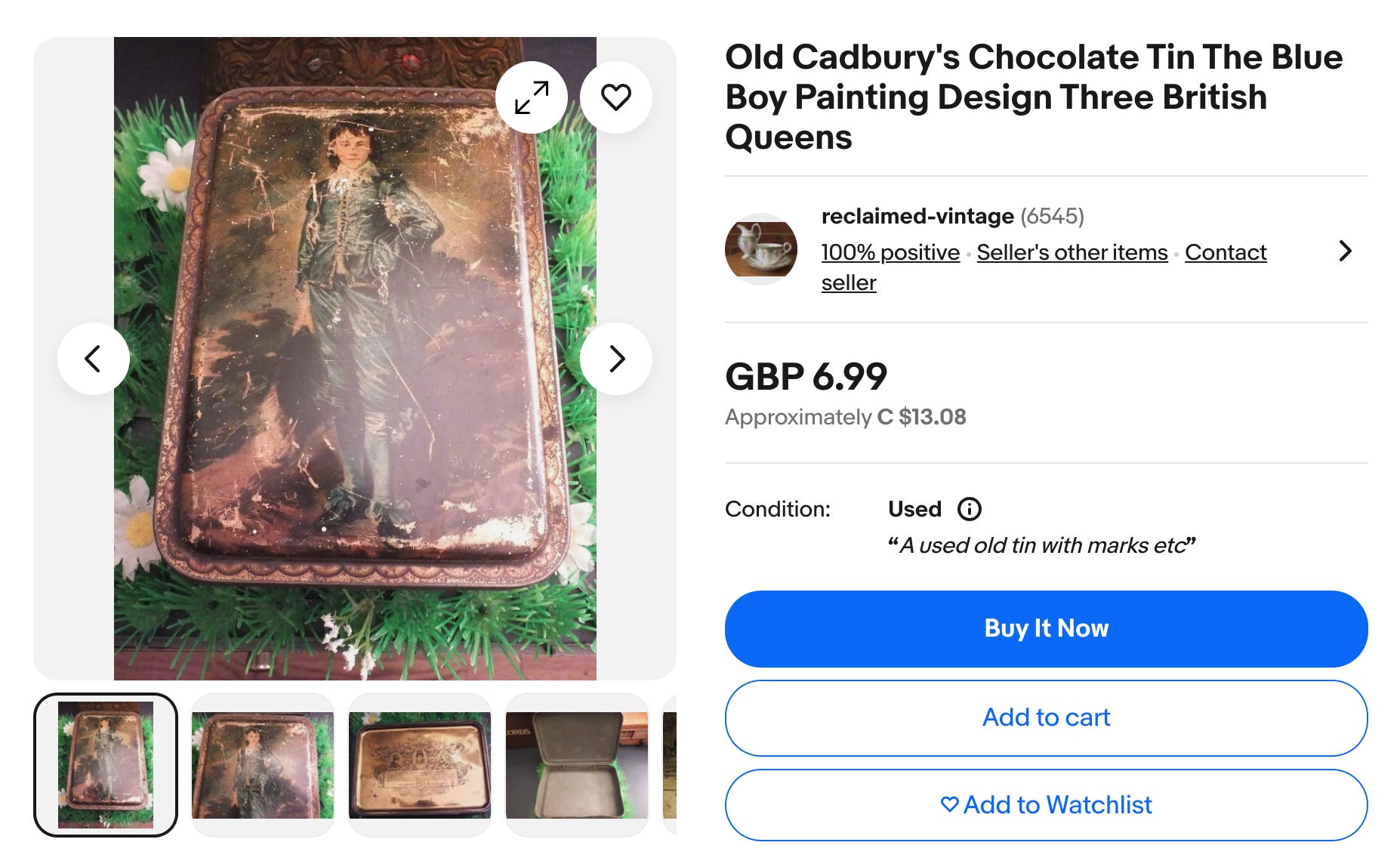
But popularity changed him. Again. As society became more rigid about what was considered “acceptable” masculinity in the 20th century, that grace started to be looked at differently. To be a Blue Boy was to flirt with artifice, with elegance, with gender play. He became a mirror, one that shifts its reflection depending on who’s standing before it.
III. Camp Before Camp
Susan Sontag might have written Notes on “Camp” two centuries too late for Gainsborough, but The Blue Boy would have fit perfectly in.
Camp thrives on tension: sincerity and irony, seriousness and playfulness. The Blue Boy embodies all of it. He’s earnest, as much as an aristocratic portrait meant to convey status, but also self-aware, almost performative with the sheer theatricality. The essence of style-as-spectacle was already there, two centuries before anyone had a name for it.
The influence stretches through fashion history. In the 1980s, Vivienne Westwood and Jean Paul Gaultier riffed on historical costume with lace ruffles, corseted silhouettes, and satin boots, and The Blue Boy’s ghost hovered over all of it. Today, Harry Styles in Gucci ruffles, pearls, and gowns channels the same self-aware elegance, the same audacious play with masculine and feminine, that Gainsborough painted into satin and lace. Camp, it seems, is never invented once, but inherited, performed, and reinterpreted.
The boy in blue walked so the boys in pearls could run.
IV. A Queer Afterlife
Now it’s when I know him. When he has become a quiet queer icon. Gainsborough likely never intended it, yet through what art historian Jonathan D. Katz calls “queer temporal drag”, the past can be reimagined through present lenses, giving old works new lives.
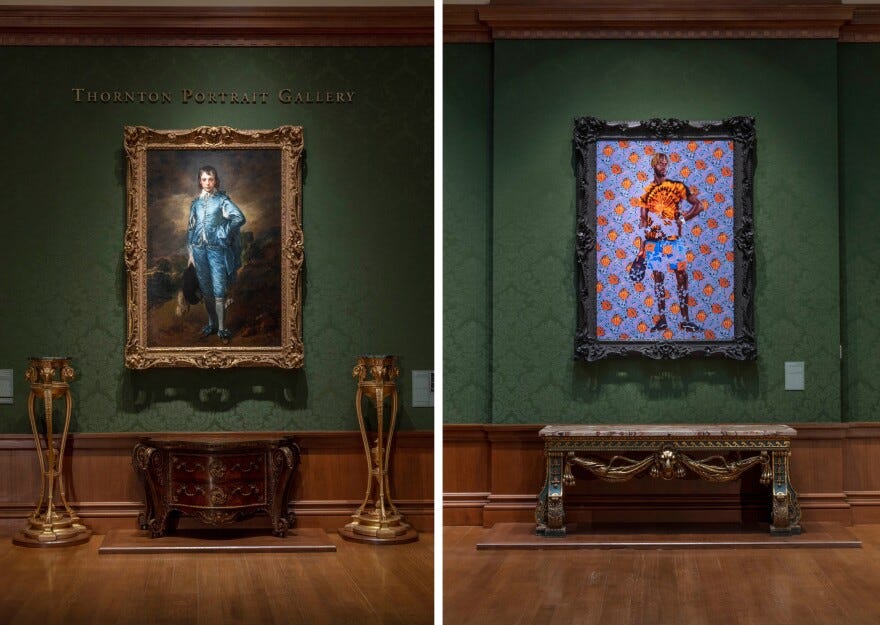
In 2021, Kehinde Wiley painted A Portrait of a Young Gentleman, a direct homage to The Blue Boy, at The Huntington Library, Art Museum, and Botanical Gardens. A young Black man in streetwear, positioned in a pose reminiscent of Gainsborough’s original. The dialogue between The Blue Boy and Wiley’s portrait exemplifies the dynamic interplay between historical art and contemporary queer reinterpretation. Three hundred years apart, they speak the same fluent language of self-presentation.
VI. The Look That Looks Back
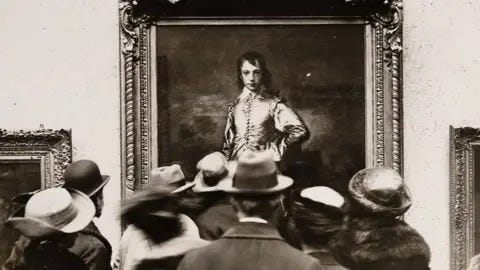
When American railway tycoon Henry Huntington purchased the painting in 1921, Britain panicked. Thousands came to say goodbye before the ship set sail. Newspapers lamented the loss of a “national treasure”, and The Times described his departure as a funeral.
Maybe what makes The Blue Boy so precious and timeless isn’t just his beauty, but his refusal to settle into a single meaning. He’s protest and poise, masculinity and softness, history and subversion, all stitched together in blue silk. He refuses to be pinned down, to be reduced to one story, one era, one idea of what a boy or a portrait should be.
Look long enough, and he starts to look back. There’s a certain defiance in that gaze. The kind that says: You can interpret me all you want. You can try to place me in a neat category. I’ll still be here, as lively and audacious as the day I was painted.
My two cents: The Blue Boy endures because beauty, when it’s brave enough to be ambiguous, never really goes out of style. Like culture itself, he evolves in our eyes, taking on new meanings with each generation. He reflects our changing tastes, our shifting ideas of identity and expression, and in doing so, reminds us of the evolution of art, of thought, of society.
He stood his ground in blue. The world kept changing around him.